The short version
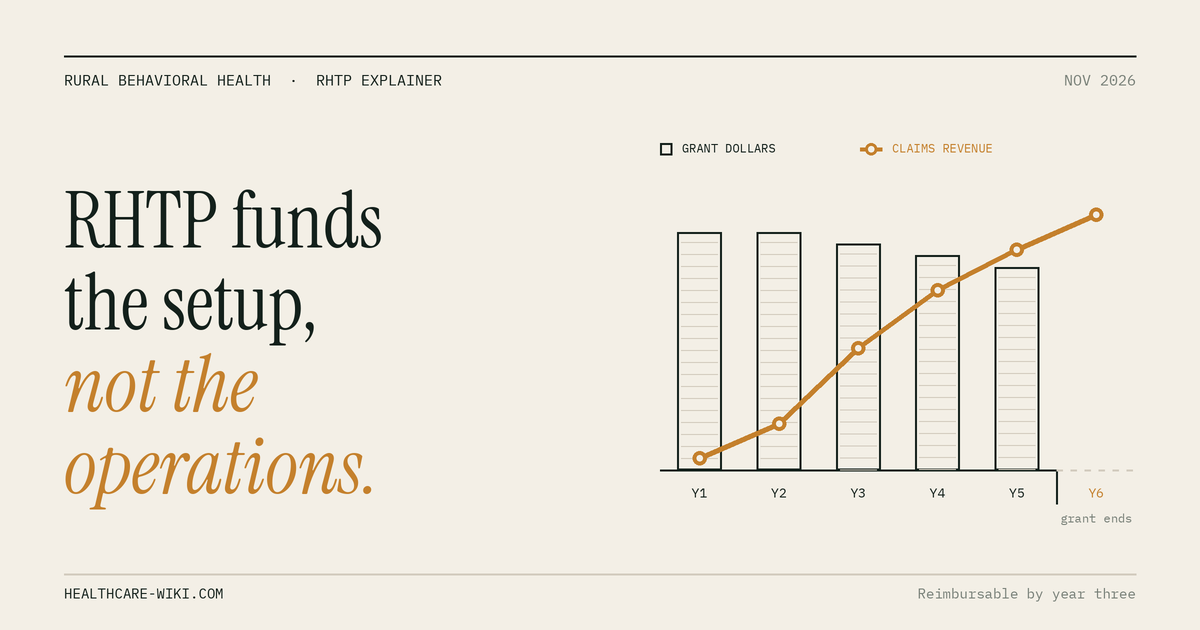
The Rural Health Transformation Program (RHTP) pays to build rural behavioral health programs, but it does not pay to run them forever. Programs that are not billing Medicaid managed care and commercial payers by year three risk closing when the grants end.
That was the core argument Alex Yarijanian, CEO of Carenodes, made in a November 9, 2026 Behavioral Health Business report on the program’s first year. This explainer lays out how RHTP money works, why behavioral health sits at the center of it, and what a reimbursement-ready program looks like.
What RHTP is
RHTP is a five-year, $50 billion federal program that pays out $10 billion a year to states from fiscal 2026 through 2030. CMS announced the second year of awards, $10 billion for fiscal 2027, on November 9, 2026, bringing the total awarded to $20 billion (CMS).
| Piece | How it works |
|---|---|
| Baseline | Every state gets $100 million a year |
| Formula share | The rest is split by rural characteristics, dual-eligible population, Medicaid data quality and the strength of the state plan |
| Year-two adjustments | Awards partly reflect each state’s progress, documented in annual reports to CMS |
| Who applies | Providers apply to their state agency, which distributes funds under state procurement rules |
| Spending window | Year-one funds must be spent by September 30, 2027; all funds by the end of fiscal 2032 |
Because the money moves through 50 different state processes, timelines and application rules vary widely. Providers interviewed by BHB described the process as slow and hard to plan around.
Why behavioral health is at the center
Behavioral health and addiction treatment are named as core priorities in 31 state RHTP plans, and all 50 plans include behavioral health improvements in some form (CMS state spotlights, as reported by BHB).
The need is large. BHB, citing HRSA data, reports that 160 million Americans live in federally designated mental health professional shortage areas, and about 90% of rural regions lack methadone-based addiction treatment.
RHTP also arrives alongside federal Medicaid changes that KFF estimates will cost rural areas about $137 billion over 10 years. For many rural behavioral health providers, the grant is a bridge across a funding gap, not new surplus.
The cliff: grants fund setup, reimbursement funds operations
RHTP is time-limited, and nothing in the program requires recipients to show how a funded service will pay for itself afterward. A clinic, mobile unit or new hire funded in year one still has to be staffed, serviced and billed in year six.
“RHTP funds the setup, not ongoing operations. A grant can open a rural behavioral health clinic, but reimbursement keeps it open. If clinicians aren’t credentialed and contracted with Medicaid managed care plans and commercial payers, the program disappears when the money does.”
Alex Yarijanian, CEO of Carenodes, to Behavioral Health Business
Yarijanian called the temporary nature of the funding the program’s biggest pitfall. He argued that awards should have required a sustainability plan up front, and that setting aside part of the money for technical assistance on contracting and billing would have been a game changer.
“The best use of RHTP dollars in behavioral health is making programs reimbursable by year three, so they can sustain themselves when the funding ends.”
Other providers in the same report raised a related problem. Small rural clinics often know their communities best but lack staff to write grants and handle reporting, so the organizations with the most need can have the least ability to use the funds.
What “reimbursable by year three” looks like

A program is sustainable when the services it delivers generate claims that get paid. For an RHTP-funded behavioral health program, that usually means working through these steps while grant money still covers the gap:
- Map the payer mix. Identify which Medicaid managed care plans, Medicare and commercial payers cover the patients the program will serve.
- Credential every clinician early. Credentialing and enrollment can take months; start when staff are hired, not when the grant ends.
- Contract with the plans that matter. Being in network with the dominant local Medicaid plans is usually the difference between a billable service and a free one.
- Confirm the services are billable. Check that telehealth, mobile, peer support and crisis services funded by the grant have matching codes and coverage in your state.
- Build billing and collections. Set up claims, denial management and underpayment review before volume ramps.
- Track a break-even date. Model when claims revenue covers operating cost, and report it alongside RHTP metrics.
Programs that reach step six before the money runs out can treat later RHTP years as growth capital instead of life support.
Key dates
| Date | What happens |
|---|---|
| Jan–Feb 2027 | Applications expected to open for rural organizations that did not apply in year one (per BHB) |
| Sept 30, 2027 | Deadline to spend year-one funds |
| FY 2028–2030 | Years three to five of awards; the target window for programs to become reimbursable |
| End of FY 2032 | Final deadline to spend all RHTP funds |
CMS redistributes unused funds over the life of the program, and recipients stay in RHTP reporting as long as they meet program requirements.
Sources and disclosure
- Behavioral Health Business: ‘RHTP Funds the Setup, Not Ongoing Operations’ (Nov 9, 2026)
- CMS: $10 billion in second-year RHTP awards (Nov 9, 2026)
- CMS: RHTP 50-state spotlights
- Stateline: Feds award $10B to states in second year of rural health grants
Disclosure: Alex Yarijanian, quoted above, is the founder of Healthcare Wiki and CEO of Carenodes, a healthcare administrative services organization that provides payer contracting, credentialing and network enrollment.